


Looking at yourself while video calling is not vanity

We see each other online more often than live, which puts you in striking situations. Maybe I ended up in a colleague's bathroom this year. Thank goodness my face was towards the door, though. But what do gestures and facial expressions actually say in a video call? And what should you better do or not do? I zoomed with Denise Dechamps from the Body Language Academy to learn everything about online body language.
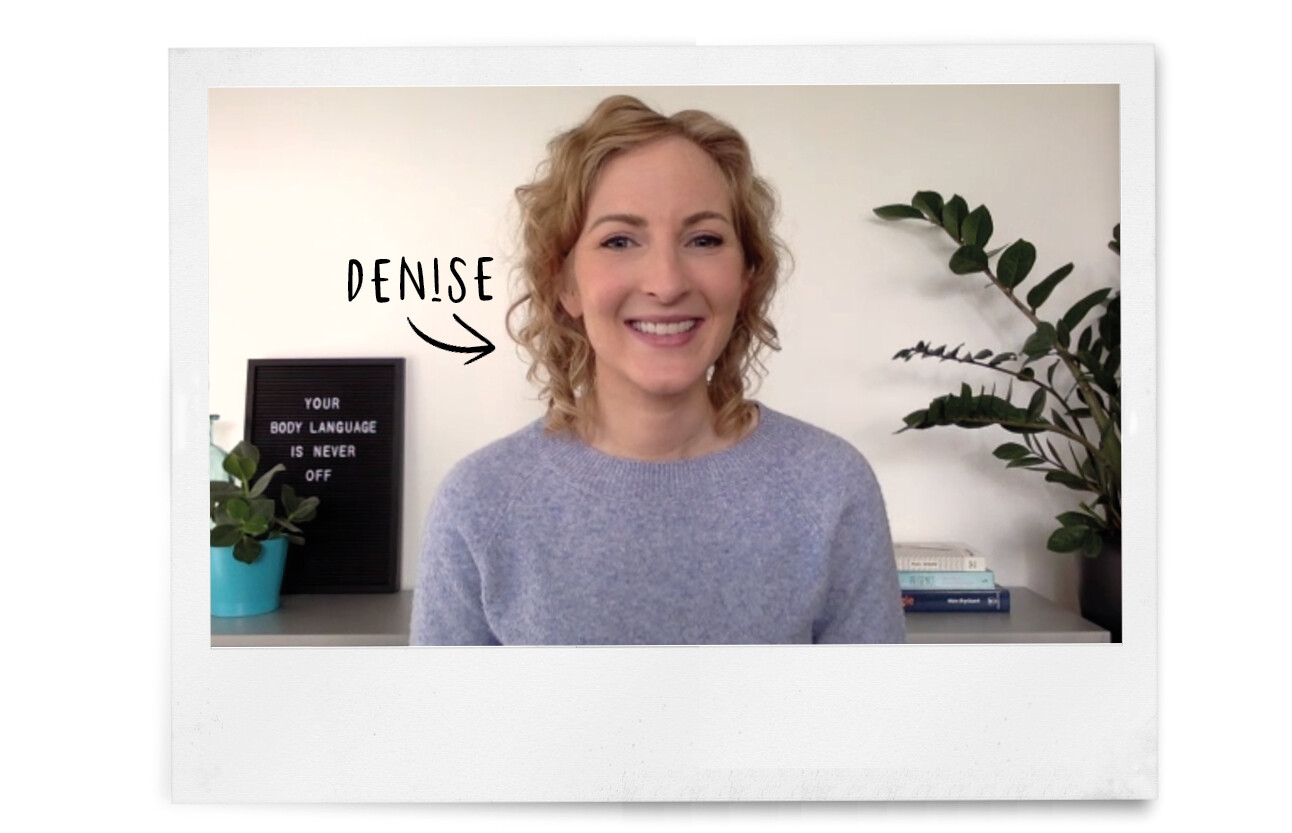
Denise, where should we start?
‘The basis is what you bring into the frame. Many people position the camera of a laptop from below upwards. Besides the fact that it’s not very flattering, you also don’t start a conversation well. The image makes it clear that it’s not a normal conversation, making it harder. The rule of thumb is: make it look as much like a real conversation as possible. Position your camera at eye level, take your navel as the lower limit and keep a few centimeters above your head. No one needs to see your crotch and the ceiling is uninteresting. If you have the frame right and you lean forward to emphasize something, then stay within that frame. Also, ensure that part of your shoulders and upper body is in view, and let this depend on how much you use your hands. Do you do this a lot? Then show less upper body. Do you do this little? Then show a bit more upper body. It’s already difficult because your conversation is 2D, so you want to make sure everything else is as normal as possible to connect.’
How do you make video calling less awkward?
‘Hide yourself in a meeting from yourself. The brain automatically focuses on the most familiar face; so it’s not vanity if you’re mainly focused on yourself in a video call. It’s a way of survival. You make this less awkward by bringing yourself small in the frame or covering yourself with a post-it. This way, your eyes are focused on the other person and you come across as less distracted. Your eyes are perhaps the most important element when zooming.’
What is the ideal setting for that online meeting?
‘I always use L-A-P. The light, then the device in between, and then the person. Eyes are super important. Often people sit with a window behind them, making it hard to see their eyes. Look for a place where all this is good. The light, and a calm background. The reflection of the light in your eyes gives the other person the idea that it’s a more genuine conversation. Think of your toy doll from childhood, it also has a sparkle in its eyes. Consider in advance how something looks. I start a different meeting beforehand to have a preview of myself. It’s just like a job interview: the first impression is lasting.’
And what should we avoid?
‘Stop touching yourself. It sounds a bit weird, but touching yourself in a frame magnifies it. If you put a hand on your neck out of discomfort, that gesture becomes very large. Just like scratching your nose. People often also adjust their clothes or hair when the camera is already on, something you wouldn’t normally do in a conversation. And if possible, also preferably don’t eat and drink as little as possible.’
What should we pay more attention to?
‘Your hands guide attention and your face shows emotions. These are the most important tools you have. So make sure they are clearly visible. And think about the purpose of your conversation. Is it a business conversation and are you wearing a jacket while the other person is in a hoodie? Then you’re already one-nil ahead.’
Knowing what your colleague thinks just by looking at their face? Stay tuned, because next time I will discuss the most striking facial expressions with Denise.


