


The Netherlands model finally tells her story
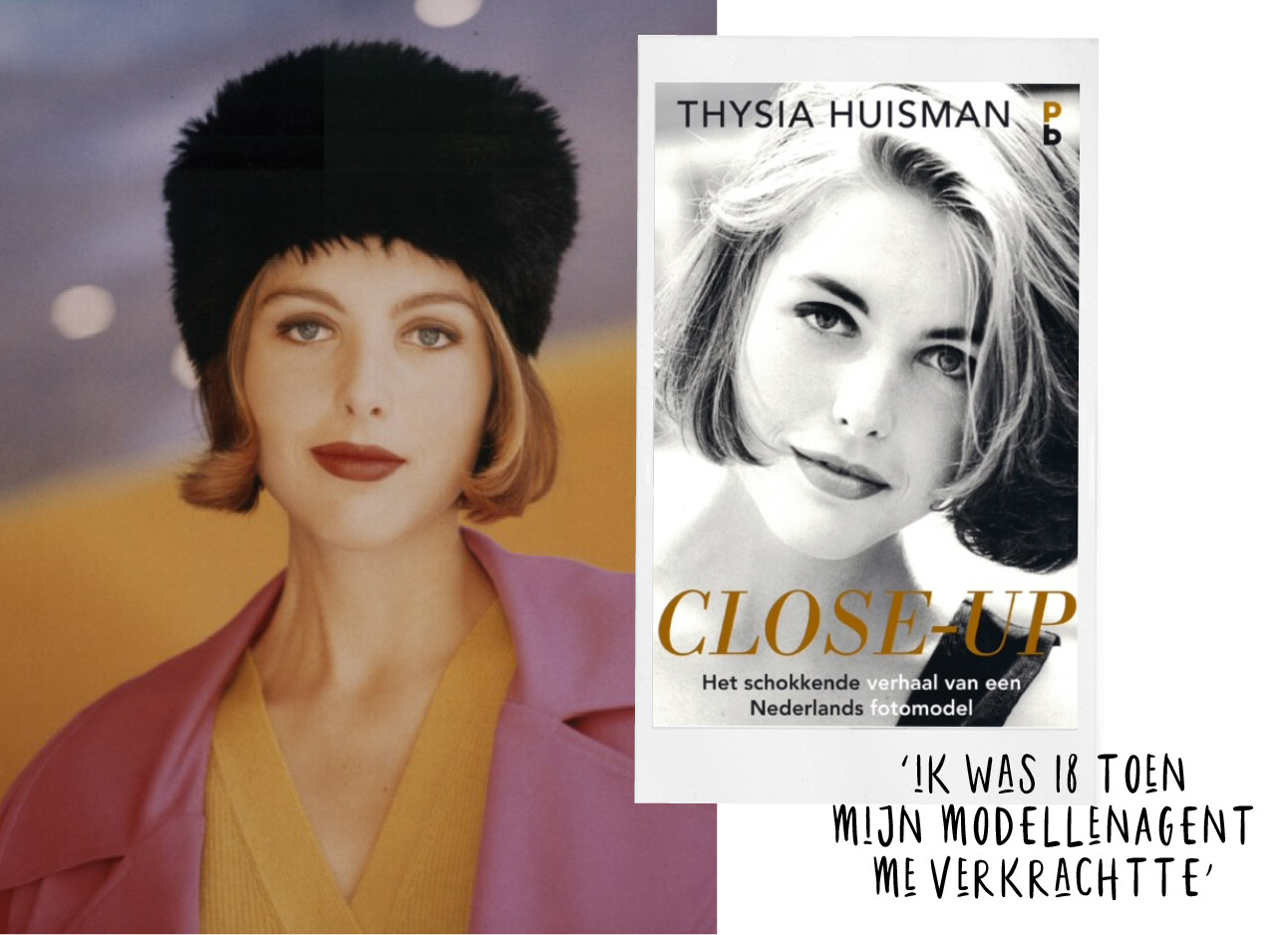
Since Alyssa Milano shot the hashtag metoo into the world, many women found the strength to tell their stories. This bundled coming-out caused a revolution. One that is still ongoing and where a brave survivor takes the stage again and again. So that we do not forget, stay alert, and the guilty do not get away with it – again. Thysia Huisman was a model and gathered, thirty years later, the strength to tell her story. The story that seemed like a fairy tale but turned out to be a drama. This week her novel Close-up is published.
Thysia, wow, you wrote a fist-thick book. Did you first look at it from a distance when you saw the first printed copy? I can imagine it must have been quite exciting to see your very personal story literally in black and white.
I must admit that I shed a tear when I finally held the first copy of Close-up in my hands. The feeling of pride prevailed, because I had been working for the past three years on writing my darkest page and that is now actually a real book.
Close-up is my personal story. It is about how I, as a young model, ended up in the clutches of the famous modeling agent Jean-Luc Brunel. I was 18 years old and a guest in his house in Paris when he drugged and raped me one evening. I decided to remain silent about it. Why? Because I was so incredibly ashamed that this had happened to me, I blamed myself for it. In the years that followed, I tried to forget it. But ultimately, I could not forget it, no matter how hard I tried, by losing myself in work, parties, alcohol, and drugs. Eventually, I realized that it did not work. I was also very depressed during periods of my life.
Only 28 years later, in September 2019, did I file a complaint against Brunel. I knew my case was time-barred (rape is time-barred after twenty years according to French law), but I wanted to motivate other victims to come forward just like I did with my complaint as a whistleblower. That is why I also consciously sought the attention of the international media. Because of my complaint, others came forward. Eleven women who had experienced the same as I did also filed complaints. Unfortunately, all cases are time-barred, so the French justice system does nothing and Brunel is still walking free. That is very frustrating. Also because he is seen today as the main girl trafficker for pedophile Jeffrey Epstein. And personally, the book makes me realize that everything that happened back then has marked my life. And that still makes me sad at times. But: pride prevails.
On the back cover it says: ‘Thysia lives with her family in Amsterdam.’ I can imagine that you want certain stories to be told for your children, but at the same time you also think: do my children want to know this about their mother? What made you think: I will do it anyway, I will write this book?
Three years ago, I went into therapy and for the first time started talking and writing about it. I do not believe in coincidence, but at that very moment, #metoo erupted. That did a lot to me because I recognized a lot in those stories about the abuse of power by Harvey Weinstein. It affected me because I had experienced that too.
Especially the feeling of shame that many victims of sexual violence have has been a driving force for me to write down and want to share my story. I hope to break the taboo that victims always have that feeling of guilt and shame.
My boyfriend and I have two sons and I understand that they do not want to read this about their mother. They are still too young now, but there may come a time when they want to read it. I want them to understand why I had to write it. I think that if you can make a difference in your life, you should do it. I felt very strongly that I wanted to share my experience so that I can turn something negative into something positive that others can benefit from. And I want to pass that principle on to our sons.
Which passage did you really struggle with?
I found the description of that one night the hardest because I knew I had to dredge it up from my memory in detail. I have postponed writing that part for a long time. Actually, that part was the only thing missing, while I had already written the parts before and after it a long time ago. When I forced myself to go back to that night and to what exactly happened, many details suddenly came back. How he smelled, what his bedroom looked like, how the fabric of the sheet felt on my skin, how he lay on me and I could barely breathe. I turned out to have stored it all somewhere in a dark corner of my head. Once I really set my mind to it, I wrote it down in one go. It almost felt like someone else was typing it.
Then there is of course the first sentence. How did that come about and where were you when you wrote it?
‘When I woke up, I was naked.’ That is the first sentence of the book. I wake up in his bed and then try feverishly to reconstruct what happened the night before. I wrote that sentence down for the first time two years ago, but only later did I decide that I wanted to start with that scene. The morning after. When I realized that morning in that bed what had happened to me, I packed my things and fled his house like a thief in the night. I took the first train out of Paris and decided never to return.
Why did this book need to exist?
Writing down my story has been healing for myself because I realized that I do not have to be ashamed, that I was a victim and had no guilt in it. To girls and women, I want to convey the following message: if something like this happens to you, know that it is never your fault, you do not have to be ashamed of it, and seek help. You are not alone. If I could do it over, I would have gone to the police and confided in someone. The fact that I remained silent for so long is something I regret in hindsight.
You are a program maker and have been telling stories for years in that sense. Yet writing a novel seems to me to be of a totally different order. How did you manage that? Did you have a coach or is it just a talent of yours?
Three years ago, I took the writing course Short Stories at the Writers' Academy. From that course, three other students and I decided to work on a larger story with the same teacher, Pauline Slot. We meet every six weeks and give feedback on each other's work. Those are fantastic meetings. I dared to let them read snippets of my story for the first time. And they reacted so positively and convinced me that I had to continue with it.
Sometimes I also found it difficult to hear their criticism and steam came out of my ears as I cycled home afterwards. I thought they understood nothing at all. Then I would tell my boyfriend when I got home that I was done with that writing. Often I had to admit a few days later that their feedback actually made sense.
This writing group was also a push to keep writing, even when I felt I had no time or desire. The fact that the book is now really here is partly due to their support.
What was your writing ritual like? Did you bury yourself in your story and were you hidden away for a period or could you also dive into your novel world for an hour and then be back on the schoolyard?
I have a family, so hiding away in a hut in the woods to write 24/7 was unfortunately not an option. I just worked at home in the living room. I would give myself a minimum number of words that I had to write that day. That worked well for me: just sit down and type. I had no time to wait for inspiration. Usually, that inspiration came when I started writing. And then I would just be back on the schoolyard. That was nice too. Just chatting about how their school day was, making something to eat, doing something fun. I also needed that to get out of the bubble of my story.
Who is your ideal reader?
Ooh, difficult. Of course, I understand that girls and women will be more interested in the subject of Close-up, although I actually hope that many men will read it too. The book has a clear message, but I would love it if readers find it a good book that reads like a train.
Does the book whet your appetite for more or was this a one-off adventure?
I have discovered that I really enjoy writing. It absolutely whets my appetite for more. I already have the idea and the outline for a second book. It is just like Close-up: based on something I have experienced myself. A toxic relationship that you cannot stop, even though you know it is better. But before I can dive into that story, I want to give all my attention to bringing Close-up to the forefront.
And where can people buy your book?
Online via Bol, Libris, and in the local bookstore. You can also order a signed copy via Scheltema.


