


For Isabel, no working day is the same
“I don't believe in ”nepobabies' at all.”
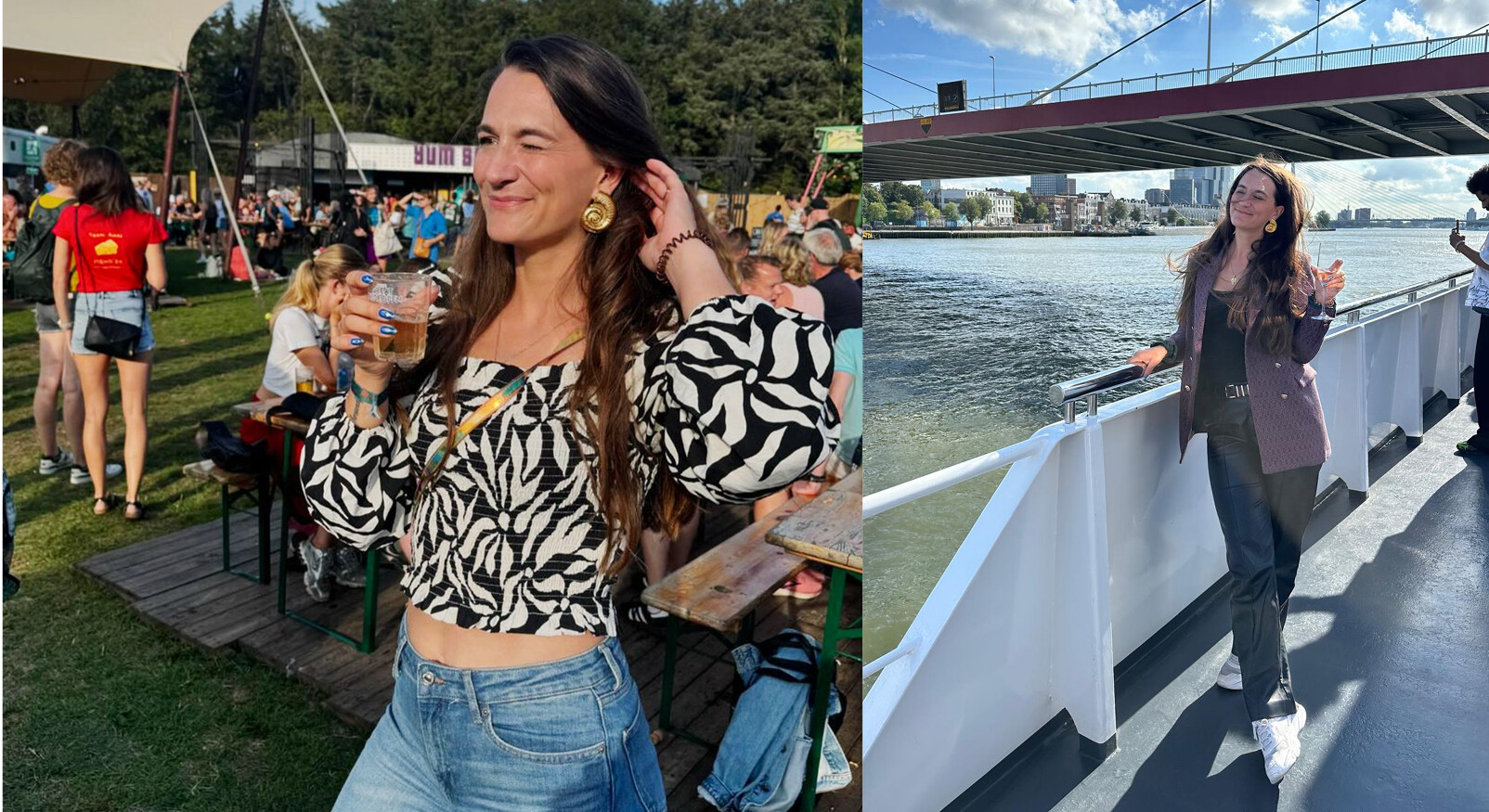
Isabel ten Brink knows very well that 9 to 5 is no longer the standard. She works for various TV programs and is an editor here at Amayzine. There are no fixed working hours and no day is the same. But it is precisely that variation that gives Isabel energy.
Describe your profession.
I always find that super difficult. What I do really varies from day to day and program to program. For the program ‘Urk’, I did reporting. That involves a lot of calling to find out what the people in the program are going to do, where we can go with them, and selecting footage that is fun for the viewers. For ‘All You Need is Love’, it is much more chaotic. There, I handle production, and you can never plan that in advance. I maintain contact with the artists who will appear in the broadcast. I also determine, together with the editorial team, the route of the Christmas bus, which depends on which people we brought to the Netherlands. We stand at Schiphol by the runway before we pick up the people at the gate, and of course, that always includes the flight attendant dance.
You combine your TV work with writing for Amayzine, how did that come about?
I was looking for something else alongside TV work. I really enjoy TV, but it is always a period of a lot of stress with a new team each time. I kept looking for writing work and then saw that they were looking for someone at Amayzine. By the way, my application almost went wrong. I thought I had sent my trial texts, but it turned out that the email was never sent. I panicked because they probably thought I hadn't finished on time. Fortunately, it wasn't that bad, and I was allowed to start immediately.
What does your average workday/workweek look like?
On Mondays, I work at Amayzine in the office, where I usually write five pieces. On other days, I am in the office for my TV work or I am filming. I work freelance, so production companies hire me to work on programs. The idea is that I write another five or ten pieces for Amayzine during the week. I plan that around my TV work. Usually, I get up around 6 AM and write one or two articles. When I come home from my TV work, I write again. It's busy, but I never mind writing.
How many hours do you work per week?
I really have no idea. With ‘All You Need’, you have to accept in December that you will do very few other things and see few people during that period. You are basically busy 24 hours a day. If someone from Australia needs you at 3 AM, I can't say I'm not available because it's night here. That is quite tough, but fortunately, you know what you're doing it for. I think that if I start counting how much I work, it will feel like a lot and heavy. Now I just keep going, and it's fine.
Did you imagine as a little girl that you would become this profession?
I have wanted to write my whole life; I love being creative. As a child, I started coming up with advertisements and sending them to companies. I was lucky that our family had worked with an advertising agency, so when I was 10, I gave that agency my idea with a complete script. That advertisement was actually filmed. That was confirmation for me that it could really work. For TV, I sent a fully developed program idea to Endemol in the hope that they would want to make a program out of it. That didn't work, but I was selected to work weekly on formats in a group of 10 people. After that, I went into production, so I was really working on one specific program.
Has the fact that your family is in the TV world influenced the work you wanted to do? (Isabel's father is presenter and program maker Robert ten Brink)
No, I don't think so. People sometimes call it 'nepobabies', but I don't completely agree with that. I have four sisters who are all not in the TV world. We have very much chosen our own paths. I don't think I have an advantage because of my parents. My father would never work with me if I wasn't good enough; he just wants to deliver the best and most beautiful version of the program.
Has your famous last name ever gotten in your way?
Yes, actually always as soon as I start somewhere new. I always have to prove myself three times harder because everyone thinks I'm only there because of my name. To be honest, I don't have much trouble with that. I know what I can do, and people will discover for themselves that I really work hard.
What education have you done, and have you gained anything from it?
A lot of different things. When I was 18, I started as a paraveterinary veterinary assistant, which means you can also operate: sterilize and castrate. After that, I studied small business and retail management through Albert Heijn. I also did communication management, but I stopped after my propaedeutics. Two years ago, I started studying Dutch at the UvA. That is part-time, and I keep looking at how much time I can free up. It has to be fun, and I shouldn't get stressed from it. For TV, it's handy if you know a bit about everything or if you have certain contacts from previous studies and jobs. For Amayzine, I think that your experiences give you a different perspective on the world and a unique style in your writing.
What advice would you give your younger self?
Everything goes as it should, and everything happens for a reason. I am also very satisfied with how everything has gone. Even becoming a young mother has only had a very positive influence. I was always super restless and busy, and when I became a mother, I became much more serious and driven. I want to be able to give my son everything and ensure that we are doing well together.
Are you the type that separates work and private life or does everything flow together?
It's not really separated. I naturally work with my parents. What is different there is that I just call my parents by their first names at work. I would never do that privately, but at that moment, it feels right.
Always reachable or type ‘two phones and Monday you’re the first’?
That really varies per program and per filming period. With reality programs, I am usually continuously available because those are ‘ordinary people’ who need you at that moment. If someone calls me in the evening for a game show asking if I have already edited a piece of music, then I will let that wait until the next day.
What do you wear on a workday?
In media, you can really wear what you want. Although on filming days, it's easier if you wear pants and sneakers. When I work at Amayzine, I wear nicer things because I know they won't get dirty. In TV, you sometimes suddenly find yourself knee-deep in mud, and then I prefer not to wear my nice white sneakers.
Do you think about perfume and hairstyle?
I usually wear my hair down and occasionally in a bun. I actually wear the same makeup every day and always perfume. That doesn't change for TV or at Amayzine.
We know it for sure: talking about money is not chic, but it's nice for the next generation to know what this work roughly pays. So can you give a rough indication?
I am very happy with what I earn in TV, but I also know that I work very hard for it. Some companies really work in scales, so they look at what another person with the same position earns. But most companies look at the experience and references you have. At Amayzine, it's just the normal amount that others in the same position also earn.
And another point of attention: being a woman. Have you experienced a glass ceiling? The idea that you had to prove yourself more?
I think that is much less in the writing world; there are simply many more women in this field. In TV, it is still the case that men still dominate in leadership positions, but there are certainly many women as well. As a woman, you are often seen as a bitch if you are clear. I don't think this has hindered me because I am quite alert to it. But I do notice that if I suggest a woman for a project, sometimes a man is chosen instead, even if he is not necessarily better at the job. That does bother me.
Has there been a moment in your career that has been decisive for your career? Where you were quite proud of your action in hindsight?
What we were able to do with ‘All You Need is Love’ during the corona period. Many programs had to stop because you could no longer be with so many people together, and we found a way to continue. Because of that, we were also extended by the broadcaster. We were able to do really cool things with Dutch and also international artists; everyone suddenly had time. For example, we were on the roof of the Ziggo Dome with Di-Rect. I am still very proud of that. At Amayzine, I have been able to develop myself from the very beginning and find my own style, and I am just very happy about that. The fact that I work there has had a lot of influence on how I engage with writing outside of my work.
Do you have any specific ambitions?
I have wanted to write a book for a long time about the special story of my family and how, for example, my grandparents met. I always had too many ideas, which made everything chaotic. But I have now found a way and have been working on it for a while. I would love it if my book were ever published.


