


There is life after Instagram
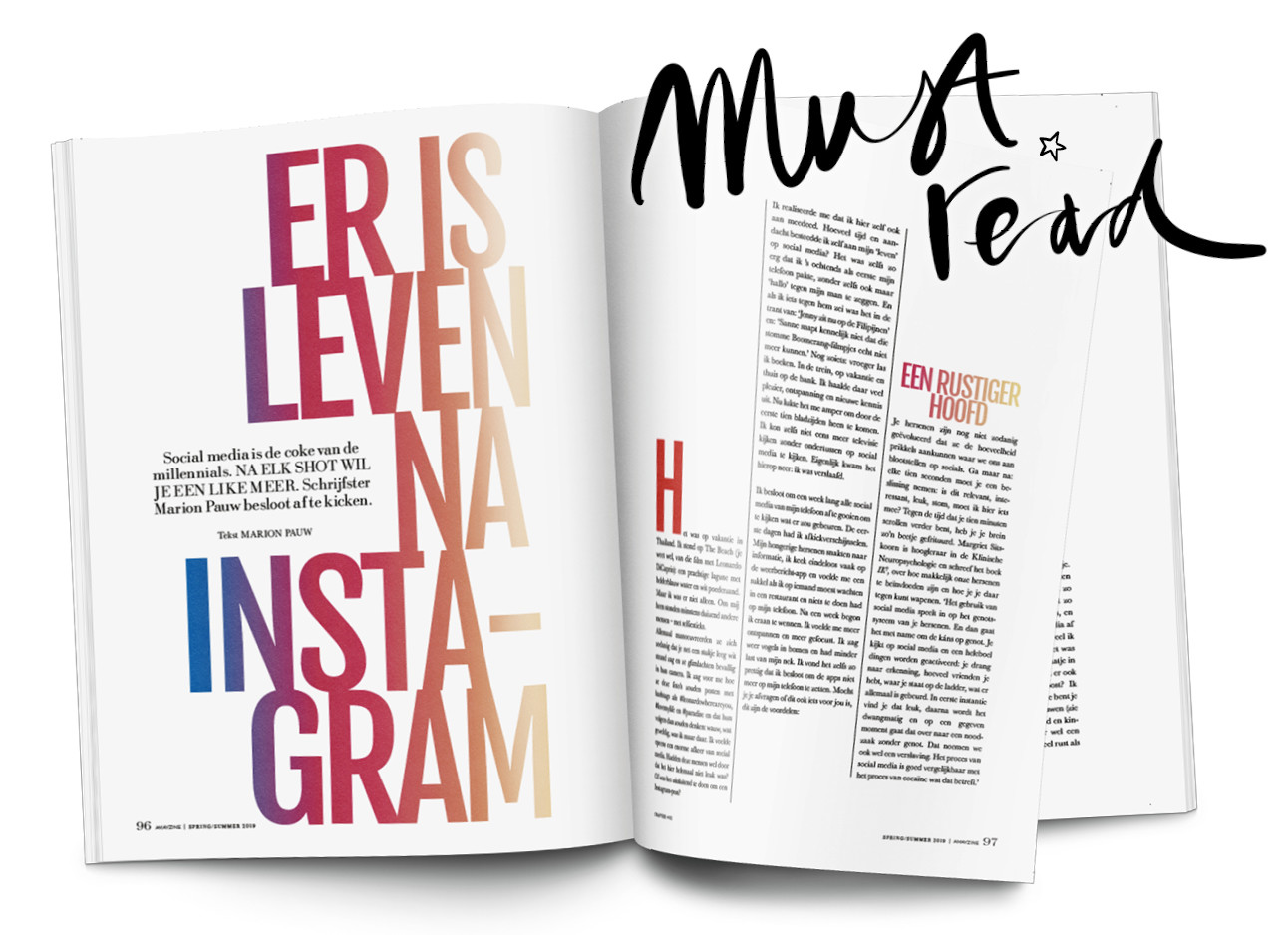
Because you might have accidentally missed a magazine: this is one of our favorite articles that you want to dive into. Fire on, warm cocoa in a mug or a bubbly in the glass (that’s fine too) and just enjoy reading.
It was on vacation in Thailand. I stood on The Beach (you know, from that movie with Leonardo DiCaprio): a beautiful lagoon with crystal blue water and white powdery sand. But I wasn't alone. Around me stood at least a thousand other people – with selfie sticks. They all maneuvered themselves
in such a way that you could just see a little piece of empty white beach and they smiled charmingly at their camera. I imagined how they would post these photos with hashtags like #leonardowhereareyou, #lovemylife, and #paradise and that their followers would then think: wow, how amazing, I wish I were there. Suddenly, I felt a huge aversion to social media. Did these people even realize that it wasn't fun here at all? Or was it solely about an Instagram post?
I realized that I was participating in this myself. How much time and attention did I spend on my ‘life’ on social media? It was even so bad that I picked up my phone first thing in the morning, without even saying ’hello‘ to my husband. And when I said something to him, it was along the lines of: ’Jenny is now in the Philippines‘ and: ’Sanne apparently doesn’t understand that those stupid Boomerang videos really can’t be done anymore.‘ Another thing: I used to read books. On the train, on vacation, and at home on the couch. I got a lot of pleasure, relaxation, and new knowledge from that. Now I could barely get through the first ten pages. I couldn't even watch television without simultaneously checking social media. Essentially, it came down to this: I was addicted.
I decided to delete all social media from my phone for a week to see what would happen. The first few days I had withdrawal symptoms. My hungry brain craved information, I checked the weather app endlessly, and I felt like a fool when I had to wait for someone in a restaurant and had nothing to do on my phone. After a week, I started to get used to it. I felt more relaxed and more focused. I saw birds in trees again and had less trouble with my neck. I even found it so pleasant that I decided not to put the apps back on my phone. If you’re wondering if this is something for you, here are the benefits:
A calmer mind
Your brain has not yet evolved to handle the amount of stimuli we expose ourselves to on socials. Just think about it: every ten seconds you have to make a decision: is this relevant, interesting, fun, stupid, should I do something with this? By the time you’ve scrolled for ten minutes, your brain is pretty much fried. Margriet Sitskoorn is a professor in Clinical
Neuropsychology and wrote the book IK2, about how easily our brains can be influenced and how you can protect yourself against it. ‘The use of social media taps into the pleasure system of your brain. And it particularly concerns the chance of pleasure.
You look at social media and a whole bunch of things get activated: your urge for recognition, how many friends you have, where you stand on the ladder, what has happened. Initially, you find that fun, then it becomes compulsive, and at some point, it turns into a necessity without pleasure. We also call that an addiction. The process of social media is quite comparable to the process of cocaine in that regard.’
Not so available
Besides a handful of good friends, a person certainly has a hundred
acquaintances. If you run into them at a party, great. At the supermarket, fine. But if you start maintaining one-on-one contact with all these people, you have no life left. By posting on social media, you constantly remind them of your existence. Hi, do you remember me, do you know who I am? Classmates from high school want to have a drink with you, an old neighbor tries to sell you a product she recently represents, and an ex from a distant past finds it necessary to message you in the middle of the night. I quickly noticed after leaving social media that the number of approaches dramatically decreased. Sure, I might have missed a few parties or a free day cream, but that is more than worth it.
You judge less
The whole setup of social media is that you have an opinion about something. Isn’t that also
the reason why people post things? That longing selfie serves to
let others say how great you are and that makes me
recalcitrant. My writer's brain is made to make nasty observations, so when I scroll through my timeline, I mainly think things like: does she think she’s sixteen, what a show-off, how can someone without talent get so far, and so on. The hardest part for me is when my friends post things that I think: what are you doing? I have friends with a terrible online persona who are amazing in real life. According to neuroscientist Margriet Sitskoorn, your brain is neuroplastic. That means your brain develops in the areas where you feed it. Judging leads to more judging. And because I prefer not to stimulate the dragon in me too much, I prefer to limit my false comments to Boer Zoekt Vrouw.
maken, dus als ik door mijn tijdlijn scrol, denk ik voornamelijk dingen als: denkt ze dat ze zestien is, wat een opschepper, hoe kan iemand zonder talent het zo ver schoppen, en ga zo maar door. Het lastigste vind ik nog als mijn vriendinnen dingen posten waarvan ik denk: wat doe jij nou? Ik heb vriendinnen met een verschrikkelijke online persona die in het werkelijke leven geweldig zijn. Volgens neurowetenschapper Margriet Sitskoorn is je brein neuroplastisch. Dat betekent dat je brein zich ontwikkelt op de gebieden waar jij het voedt. Oordelen leidt dutot meer oordelen. En omdat ik de draak in mij liever niet te veel wil stimuleren, beperk ik mijn valse opmerkingen liever tot Boer Zoekt Vrouw.
Classmates from high school want to have a drink and an ex from a distant past finds it necessary to message you in the middle of the night
The little voice in your head that says about everything: what would my 3415 followers think of this?’
You’re at a party with a friend. Your dog does something cute. You have a
six-pack. Of course, you post this with as many hashtags as possible because hopefully, you’ll get even more followers, and that’s what you want. When I left social media, I didn’t realize how much I was actually engaged in this. It was as if there was constantly a little program running in my head about everything that happened: is this a post? I understand that if you’re happy about something, you want to shout it from the rooftops (see all the photos of my husband, dog, and children), but you do pay a price for this. It gives a lot of peace if you can just be somewhere.
You have less trouble with your ego
Deep down, we are all soft and pure. You just don’t want to expose your tender soul to the outside world. That’s why you put a Teflon layer in front of it, also known as your ego. Your ego layer is how you look, your status, the desired image for the outside. The ego constantly needs validation, so you can guess how social media plays into that. Yes, even that makeup-free selfie with #ikbengewoonmezelf is an ego thing. Or that photo with sad children. Because you still want people to say: ‘Oh, how brave.’ Or: ‘Oh, what a beautiful person you are.’ If people don’t respond, or don’t respond as you wish, you feel a bit hurt and might even try harder. What you feed grows. Just like with plants. Facebook and Instagram are, in my opinion, like Pokon for the ego. If you stop feeding your ego, there’s more room for less bullshit.
You have more desire for real people
You can only remember a certain amount of information in a day and you can only handle a certain amount of social interaction in a day.
Because of social media, you are already involved with a lot of people. You know when they’ve been to the dentist, how great their vacation was, and what they ate last night. Your curiosity about what other people are doing is already satisfied. I’ve noticed that since I’m no longer active on social media, I have more desire to talk to people. Sometimes I miss events or don’t know that someone had a birthday, but when I talk to them afterward, at least we have something to talk about.
It saves time
This seems very obvious, but I’ll mention it anyway. If you have an iPhone,
you can see what your screen time is per day. You probably get completely
shocked. I used to spend a calm hour a day on social media, if not
more. Now you can say that you use social media in the time you have ‘left over’, but then you’re not resting enough in these times of overstimulation. In an article in the Belgian newspaper De Standaard, Suzan Kuijsten (from the book Gek op stress) says: ‘Stress is not the problem in itself. Lack of recovery is where it’s at. Stress that persists is toxic. After every peak moment of stress, a recovery moment must follow.’ Those moments when you’re staring out the window because your date is late are necessary to release stress and recharge yourself for the next peak moment.
People do less talking about you
I really love to travel, and that was evident on my social media. As a result, people got the impression that I was always on vacation. So did a client who had viewed my Instagram and concluded
that it was impossible for me to have spent enough time on his project.
People also always greeted me with: ‘You’re doing really well, aren’t you?’ Dare to claim that it’s not so. Of course, I contributed to these assumptions myself. I’ve found that I prefer it when people approach me openly. And I also think now: it’s nobody’s business that I’ve indeed traveled again.
You become a nicer person
We all know them: those couples sitting across from each other in a restaurant
on their phones (guilty). That you’re looking at Facebook and your child asks if you can come and you then say: ‘Wait a minute, sweetheart.’ We haven’t become more social in our daily interactions because of social media. But in addition, something actually happens in the brain that makes you less social. Margriet Sitskoorn: ‘Social media constantly demand short-term attention from you. Just this, just that. Your brain is not made to switch attention so quickly all the time, and that creates stress.
aandacht te moeten wisselen en dat levert stress op.
On top of that, you’re less able to work on your long-term goals. Because let’s face it, you start scrolling and before you know it, an hour has passed. This causes you to experience even more stress. That actually damages cells in the part of your brain called the hippocampus. Due to that damage in
your brain, behavioral changes occur, and you become forgetful and get irritated more quickly.’
It’s nobody’s business that I’ve indeed traveled again
I’ve now been clean for three-quarters of a year and have quietly finished my book De experimenten. When it came out, I posted a photo of the
cover. Immediately, the restlessness strikes again. How many people would have liked it already, do they think it’s nice, do they think I’m good, are they happy that I’ve written another book? And while I look at reactions to my post, I immediately check my timeline again. I look at my phone ridiculously often and it doesn’t feel pleasant at all. I could consider not promoting on my own channels or even quitting my accounts. But isn’t that a bit of a shame? I do have 5000 Facebook friends, 4192 Tweeps, and
hebben, vinden ze hem mooi, vinden ze mij goed, zijn ze blij dat ik weer een boek heb geschreven? En terwijl ik naar reacties op mijn post kijk, neem ik meteen even mijn tijdlijn mee. Ik kijk weer belachelijk vaak op mijn telefoon en het voelt helemaal niet prettig. Ik zou kunnen overwegen om dan maar geen promotie te doen op mijn eigen kanalen of om zelfs mijn accounts op te zeggen. Maar is dat niet een beetje zonde? Ik heb toch 5000 Facebook-vrienden, 4192 Tweeps en
3415 Instagram followers who might be interested.
Whether I will ever completely stop using social media, I don’t know. I’m increasingly leaning
towards a yes. I do know that I have to handle it very consciously and not lose myself in endless scrolling. But just as I stopped smoking years ago and now occasionally have a cigarette at parties, I should also be able to manage social media. Right?
If you’ve been inspired by this story, I recommend you try it for a week. Just remove all the apps from your phone and don’t post anything for a while. If you need to post things for business reasons, do it from your computer and set specific times for yourself. I’m curious about your experiences.


