


5 questions about laser treatment
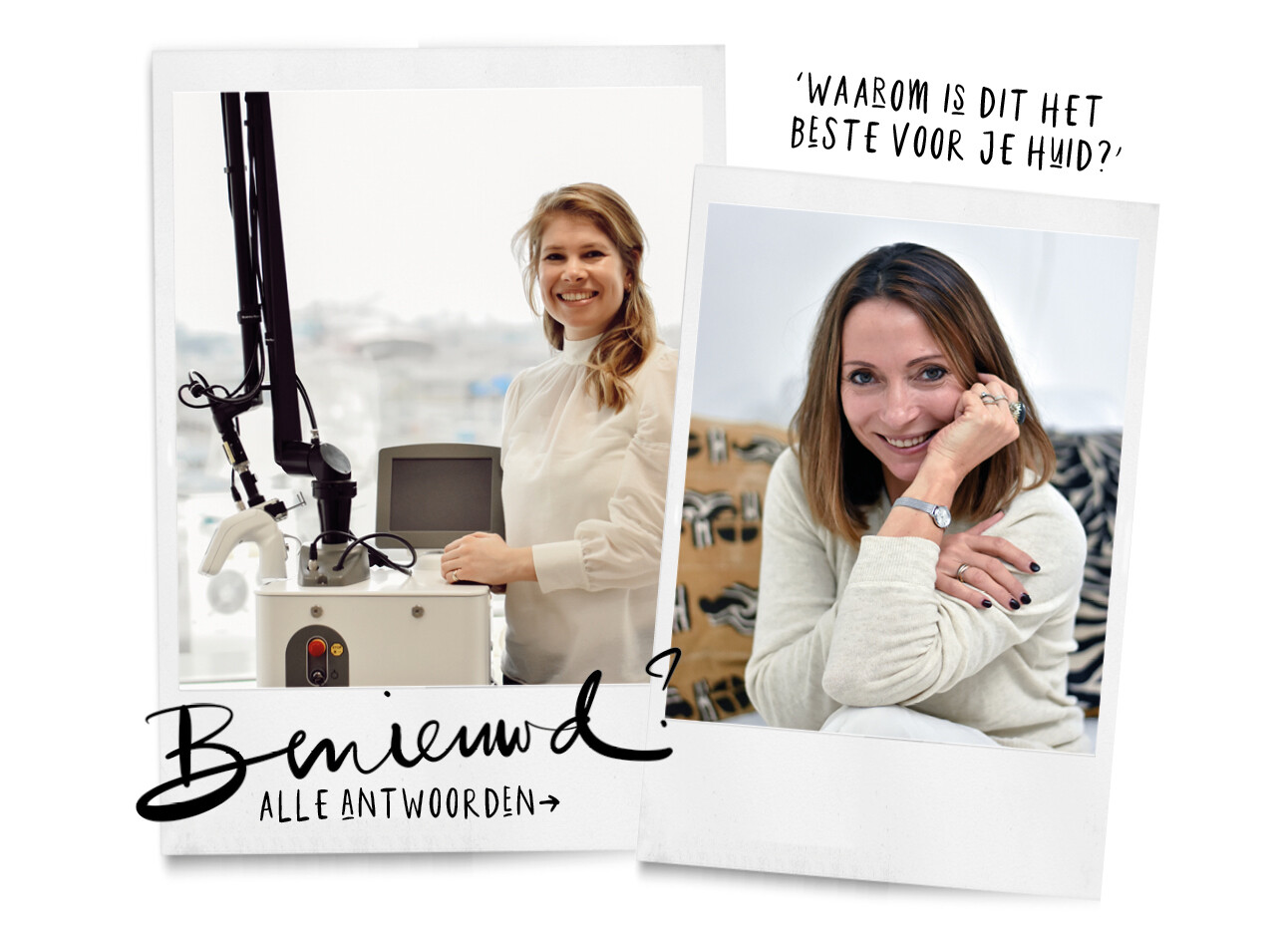
‘When are you going to do something about that red spot?’ I’m sitting in the chair with Leco, whom I’ve only known for a month, and hats, there my pain point is being discussed. A slightly less desired souvenir after a sabbatical in Rome is a spot of at least two by two centimeters on my right cheek. I have rosacea and rosacea and a polluted city are like Amber Heard and Johnny Depp; they don’t bring out the best in each other. Leco immediately proposes a solution: laser that thing. So off I go to Cornelis Schuyt, where the laser treatment turns out to have a lot of side effects. Pleasant side effects for a change. Irregularities, pimples, pigment spots disappear and even wrinkles become less. How did it end with the red spot? It was completely chased away and wiped out after four treatments. Just like that.
Since then, laser treatment has become a fixed part of my skincare routine. Two to three times a year, I go to Annelijn van Ierland who runs her Skin Kliniek (right next to the A2 near Utrecht, you’re there in no time) her Skin Kliniek. Annelijn looks at the most suitable treatment for your wish, I puff away the little pains for half an hour (you can feel it), look at a somewhat puffy face the next day to discover a fresher version of myself over the next week. In the meantime, I’ve gathered a lot of girlfriends who are all team Annelijn, but I understand that you need a bit more information to also make the trip to the laser, which is why I’m firing the five most frequently asked questions at Annelijn.
1. Can you explain what laser treatment of the skin is exactly and why it leads to skin improvement?
A laser produces bundled light in a beam, at a specific wavelength (color light/nanometer) allowing you to work very specifically and purposefully in the skin. Laser therapy is a beautiful technique with which you can purposefully and safely treat many skin problems such as UV damage, pigment spots, acne, and superficial blood vessels (couperose), but also tackle signs of aging (read: wrinkles, fine lines, and skin laxity). The laser goes through the skin, and the target on which the laser works absorbs the laser light, which is converted into heat.
There are roughly two types of lasers: non-ablative lasers, which work by coagulation, and ablative lasers that ‘vaporize’. Vaporizing with the ablative laser: skin cells contain a lot of water, and when you apply a laser whose energy is absorbed by water, you essentially vaporize the skin cells. For this, we use a fractional CO2 laser. If, for example, the target is aimed at the red dye (hemoglobin) in the skin to remove couperose or superficial blood vessels, then it’s not about the ablative but mainly about the coagulating effect of the laser, and an ND-YAG (1064 nm) or a specific IPL is applied.
Vascular lasers respond to hemoglobin (redness in the skin), causing the light to be converted into heat. This makes it possible to safely remove superficial blood vessels. Pigment lasers use heat to break down excess pigment, which the body then clears away. CO2 lasers can reach deeper skin layers and vaporize water in the skin, stimulating collagen and elastin production. This reduces wrinkles and scars.
There are also lasers that target protein (collagen) in the skin. For skin-improving lasers (such as the CO2 laser and the 1540 non-ablative), you now have the technique ‘fractionated’: this is a nice development where the laser beam is divided into many small laser beams. Small ‘fractions of the skin’ are treated. This has greatly reduced the chance of complications and the recovery time after a laser treatment is much shorter than with older lasers that are not fractionated.
For a layman, it can sometimes be quite difficult: there are many different lasers, each with a different purpose in the skin. A practitioner (or practice) can say that they offer laser treatments, but what kind of laser exactly? Sometimes the type of laser is not mentioned, but only an attractive (often commercial) name for the treatment. Additionally, the quality of the laser machines also varies.
2. Can I also have a laser treatment in the summer? Is it bad to go in the sun with my skin afterwards?
Do you faithfully apply an SPF 30 cream every day and are you not a sun worshipper? Then it is possible to be lasered all year round. Depending on the type of laser, unwanted hair growth, general skin improvement, fine lines and wrinkles, (acne) scars, redness/vessels, and active acne can be treated throughout the year. At the moment the skin is recovering from the laser treatment, the chance of pigmentation after the treatment is slightly higher. Therefore, it is wise not to go directly into the full sun after a laser treatment. Always consider the planning around sun vacations. Also be careful with tanned skin; not all lasers are suitable for that, and definitely do not have an IPL treatment done if you have just returned from a sun vacation.
I would generally not advise laser treatments for reducing pigment spots to be done in the summer, but they are best applied from October to March, when the UV intensity in the Netherlands is lower. Do you want to start with laser hair removal and be hair-free before summer? Then it is wise to start in the fall, as multiple treatments are always needed.
3. How does getting fewer wrinkles through laser treatment work? What process occurs in the skin?
The best approach is to apply a combination of a fractional CO2 laser (10600 nm, ablative) that controlled vaporizes the skin at the surface and a fractional laser (1540 nm, non-ablative) that works deeper in the skin on the protein collagen and provides firmness. It is the Youlaser MT (from Skin Kliniek) that does this.
This laser, actually two lasers in one, works simultaneously in the skin. The intensity of both lasers can be very specifically adjusted to skin type (all skin types can be treated safely) and the degree of skin problems/wishes for skin improvement. Do you have thick or thinner skin, early signs of skin aging, laxity, a lot or little sun damage, fine lines or deeper wrinkles? Then this is the laser that makes the skin smoother and reduces wrinkles, skin structures, sun damage, and (acne) scars.
Through this laser treatment, the skin is controlled at the surface and thus ‘damaged’ in a controlled manner and then set to work. After the treatment, during recovery in the second skin layer (dermis), the production of collagen and elastin is stimulated, which results in smoother skin, finer skin texture, fewer fine lines/wrinkles, and more elasticity of the skin. This way, all signs of skin aging (also preventively) are addressed.
4. Is laser treatment dangerous? Can everyone do it, and can you do it too often?
Laser treatment is not dangerous. However, it is of course important to have the treatment performed by an experienced and laser-specialized skin therapist or doctor. It is also important that the practitioner is aware of your general health and medical history, so that there are no surprises. Sometimes crusts, redness, and/or swelling occur after a laser treatment. These complications are temporary.
What many people do not know is that laser treatments (at Skin Kliniek we have various specific lasers (applicable to all skin types) that are possible for all skin types. Just be careful that the right laser is applied.*
- On average, the skin needs a day to a week (sometimes two) to recover, depending on the type of laser treatment.
- On average, there are four to eight weeks between the laser treatments at the beginning, and to maintain an optimal skin condition and result, you should have a maintenance treatment done two to three times a year.
*When a laser treatment is not performed correctly or a laser is used on a skin type or skin problem for which it is not suitable, this can have (serious) consequences such as burning of the skin and sometimes even (permanent) scars.
5. How do I know which laser treatment I should choose?
For every indication, there is a type of laser with its own specific wavelength. Laser light is light at one specific wavelength (nm) and nanometer (color light) and works on specific skin components in the skin. The red dye in blood (hemoglobin) absorbs wavelengths 500-590 nm and 1064 nm, which can treat couperose well. Melanin is the pigment in your skin and absorbs 755 nm. Lasers at this wavelength are therefore well suited for laser hair removal and the removal of pigment/age spots. Water primarily absorbs 10,600 nm (CO2 laser) and collagen (protein) absorbs 1064 nm and 1540 nm. This is well used for general skin improvement/reducing fine lines and wrinkles.
A combination of different laser treatments is often applied for the best result. No skin is the same. Always get good advice from an experienced and certified, preferably a laser-specialized skin therapist, who looks at what the best laser treatment is for your skin.


