


Acne tips you don't know yet (but do make a difference)

Acne. We all know it and often we immediately think of skincare to solve it. The right cleanser, that one serum, maybe an exfoliant or even stronger products. But honestly? An acne-prone skin often requires more than just what you put on your face. And now I hear you thinking: easy for you to say with your smooth skin. But believe me, my skin has also been anything but calm for a long time. Red bumps on my cheeks, pimples even along my hairline: I’ve been there. Because no matter how good your routine is, there are so many factors that influence your skin. And a large part of that happens outside your toiletry bag.

If your skin is acne-prone, you probably know most of the tips. Your browser history is probably full of them. But just to reiterate, the basics that really make a difference:
Your pillowcase
I sleep on one side one night and the other side the next night, and then it goes in the wash. Okay, fair enough: not very environmentally friendly, so I alternate between several pillowcases. But for my skin, it really makes a difference. At night, sebum, sweat, and product residues accumulate, and if you lie on that for too long, your skin just becomes more restless. Since I started doing this, I notice that my skin stays calmer and, bonus: my hair also gets greasy less quickly.
Don’t overdo it
As tempting as it is: over-exfoliating your skin often backfires. I once used a way too aggressive cleanser (do you remember Clearasil?) and only made it worse. It wasn’t until I switched to milder products and gave my skin some rest that it got better. Too many active ingredients, frequently switching skincare products due to trending items just confuses your skin. You only really know if a product suits you after thirty days. So give your skin some time.
So I drink quite little water and am always scolded by
No miracle cure, but still important. Hydration helps keep your skin barrier strong.
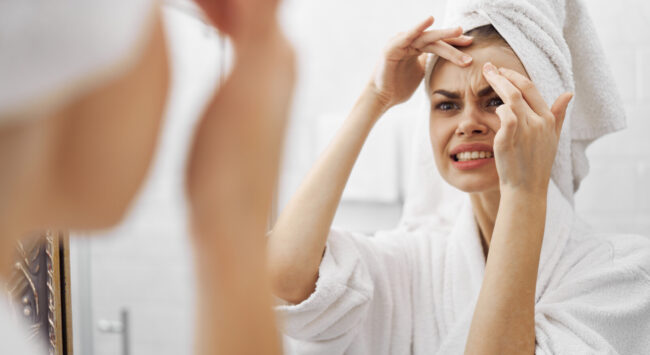
Hands off your face
Yes, really. Leaning and scratching your nose counts too. You touch everything all day, don’t wash your hands continuously, and then touch your face with hands full of bacteria and dirt. Do you see spots in your makeup at the end of the day? There’s a good chance this isn’t due to your makeup, but to your hands. Iewl.
Last but not least: the air in your home
And then something that is actually rarely talked about: air quality. We are becoming increasingly aware of what we put on our skin throughout the whole skinification trend, but we often forget what hangs around your skin. With the nice weather, we are outside more and have our windows open more often at home. Wonderful of course, but you also bring in pollen, dust, fine particles, and other (invisible) dirt. You can sometimes literally see it dancing in the sunlight. And that has more effect than you think.
According to research by dermatologist Emma Craythorne en Dyson has polluted air really affects your skin. And actually, that's not so strange, because you might not see it, but your skin is busy all day defending itself against all that dirt. And you can notice that by more redness, a duller complexion, or suddenly that greasy layer that you didn't have before. But also:

Your skin loses firmness faster
That constant “stress” also affects your collagen. And collagen decreases quickly from your 25th year (read all about it here). Your skin needs collagen to remain supple and firm.
Your skin is drier and more sensitive
Your skin barrier becomes unbalanced more quickly. And if it doesn’t work well, you notice it immediately: your skin can feel drier and more sensitive, but also pimples and other impurities can develop more quickly.
You are more likely to get pimples
Especially if you have acne-prone skin, this can play a role. Pollution causes your skin to produce more sebum, which can become thicker and stickier and more easily get stuck in your pores. Combine that with dust particles on your skin and you have exactly what you don’t want: clogged pores and quicker breakouts.
And your sleep also plays a role in this
Are you a bad sleeper? Then check the air quality in your room. Opening a window isn’t always enough, because even if the air feels fresh, it can still be full of invisible particles. These not only affect your skin but can also influence your sleep. And such a bad night shows up immediately in the mirror: dark circles, fine lines, and skin that recovers less quickly from impurities.
What can you do about this?
Fortunately, we don’t have to live in a sterile bubble, but small adjustments can already make a difference:
- Ventilate consciously (not in the middle of a busy, polluted day, especially if you live on a busy street)
- Keep your bedroom as dust-free as possible, so vacuum regularly and store clothes in the closet and not on a clothing rack
- Clean your skin well in the evening (we are fans of double cleansing: one to remove makeup and superficial dirt and a second to really clean your skin)
- Or shop for an air purifier, like the newly launched Dyson Hushjet Compact Purifier. This removes 99.97% of those particles so small that you can hardly see them with the naked eye and that your skin doesn't like.
See it as an extra for your skincare: not just applying, but also improving your environment a bit.
Pssst: just a small sidenote:
Don’t see this as the solution for acne, but as something that is often forgotten. Acne is almost always a combination of multiple things: hormones, skincare, stress, nutrition, and also your environment. Do you often suffer from an restless skin or do breakouts keep coming back, no matter what you try? Then these tips might make a difference. But if your acne remains severe or painful, it’s always wise to visit your doctor or dermatologist.
Source: Dyson


