


Reformer Pilates, the ultimate guide
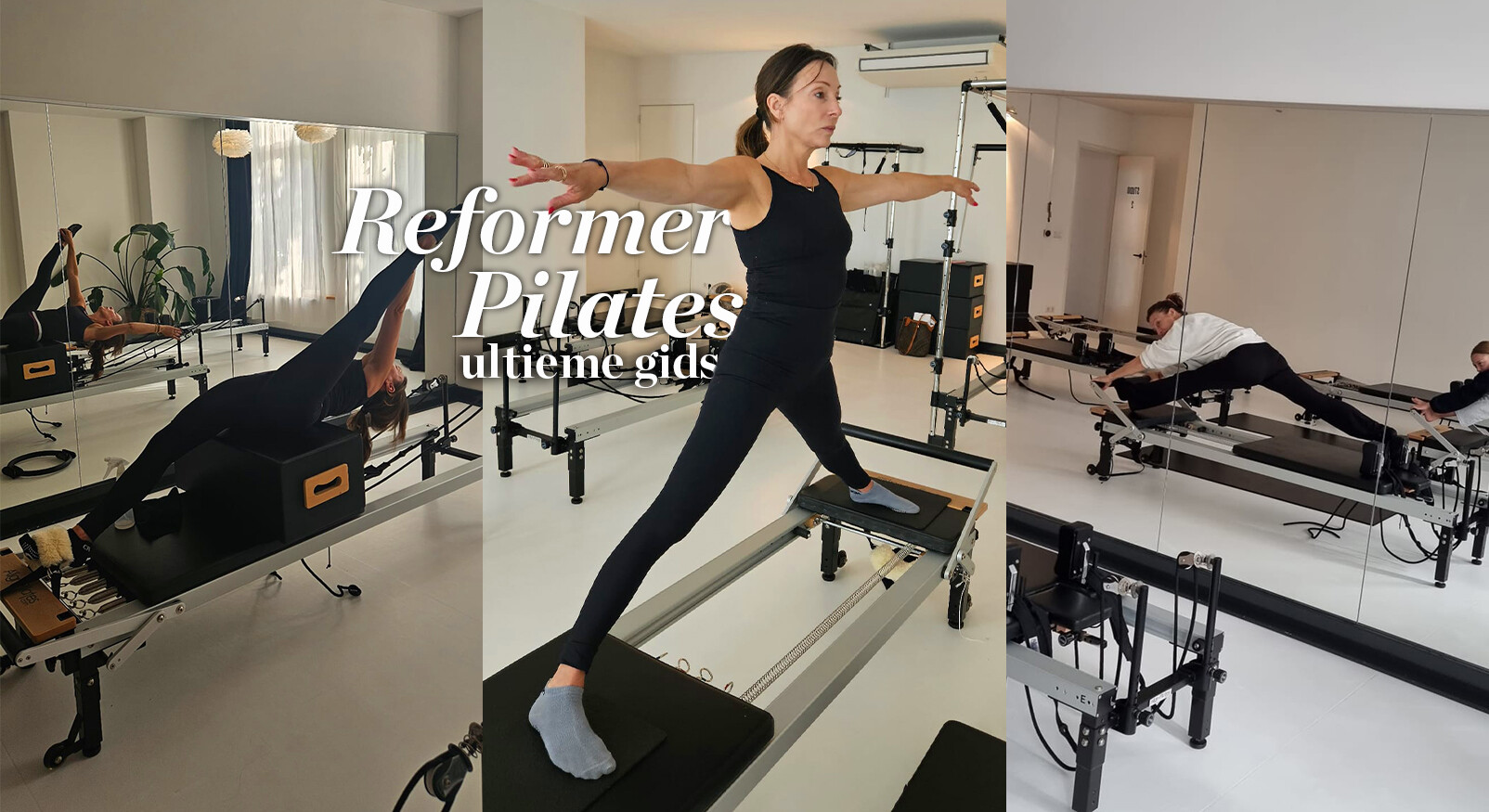
If I hear for the umpteenth time during a massage that I ‘really need to do something about those shoulders’, I sign up for reformer pilates. Yoga is a bit too airy-fairy for me and I have read about how Madonna sculpted her body in the Cadillac – a special version of the reformer – about twenty years ago. So if I could do something about ‘those shoulders’ and at the same time work on a strong and flexible body, that would be a case of 1 and 1 is 3. At least. Since then, Reformer Pilates has been my great love and I lie on the famous carriage four times a week, if not more.
What exactly is Reformer Pilates (and why do you want to do it right away)?
Reformer Pilates is a part of regular Pilates, a movement method developed by Joseph Pilates after World War I. Reformer Pilates is suitable for muscle strengthening and rehabilitation, and by working with the reformer, the strain on the joints is minimal, reducing the risk of overuse and injuries. What was a very important learning component for me was to work precisely and calmly. If you make your movements too abruptly, the chance of falling off the reformer is quite large.
The reformer is a device with a movable part, the carriage, from which you perform various exercises. Apart from the carriage, you have an adjustable footbar, shoulder supports, and foot and arm straps. Additionally, there is a platform for footwork and a box with which you can also perform various exercises. It's quite a hefty piece of equipment, such a reformer, and that also explains the price of the lessons. It's a significant investment, such a reformer pilates, and you need to see a return on that.
The six basic principles of Reformer Pilates according to Joseph himself
Breathing is the most important aspect of Reformer Pilates. According to Joseph Pilates, good breathing is purifying because it adds a lot of oxygen to your blood, thus having a cleansing effect on your entire system. The mental component is also very important in Reformer Pilates, and a good breath is very purifying for the soul.
The other principles on which Reformer Pilates is based are: concentration, control, precision, centricity (in other words; working from your core, your center), breathing, and flow. You move in flowing lines without stopping. An ideal sequence is when you connect one exercise to another, making the entire session a whole.
Why Reformer Pilates makes you more flexible AND stronger
The special thing about Reformer Pilates is that you work on both gaining strength and flexibility. You need to be as flexible as you are strong to excel in Reformer Pilates. As I write this, I find it important to mention that it is very much about personal progress. Of course, there are beginner and advanced classes because in the latter you will do more challenging things, but the beauty of a reformer class is that you are very much focused on yourself.
You need your total dedication to complete a class well. Sometimes just looking in the mirror can be challenging when trying to maintain your balance. That's what I find so beautiful about it. You are in a group but also very much in your own flow.
How the springs of the Reformer Pilates machine determine your workout
The reformer machine has different springs that allow you to determine the weight of an exercise. One exercise can be very heavy on light springs because the carriage does not ‘bring itself home’, but you have to do that. Another exercise can be heavy on heavier springs, it all depends on which direction you are moving.
When you have clicked all the springs, the carriage is almost immovable, and you can safely stretch your back completely over the box. It all sounds very complicated, but once you've done a class, you'll understand what I mean.
What does Reformer Pilates cost? Everything about classes and equipment
The price of a reformer ranges from around €1100 for a home device to as much as €10,000 for a professional machine. It depends on the material, all extras, etc. You also need to maintain the reformer properly and regularly lubricate the springs; otherwise, everything moves more stiffly.
Classes cost about €20 to €35 per hour because the investment needs to be recouped, and because instructors must have completed special training and they are also more expensive than the average instructor.

What is the difference between Pilates and Reformer Pilates?
The biggest difference between Pilates and Reformer Pilates? Simply put: mat versus machine. In ‘regular’ Pilates, you do the exercises on a mat, often just with your body weight. Reformer Pilates, on the other hand, takes place on an impressive machine full of springs, straps, and a sliding carriage (you know, that sliding part you lie on). This allows you to work much more precisely on strength, mobility, and control — and you can adjust the intensity. The result: Reformer Pilates is just that little bit more challenging and more full body than the mat version. Think: more muscle shaking, more results, more “wow, did I just do that?”
Why celebrities swear by Reformer Pilates en masse
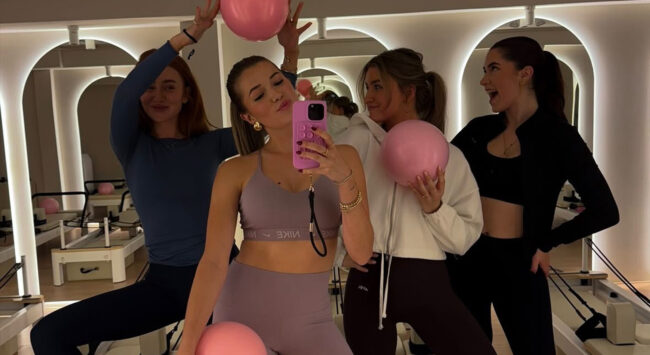
Which celebrities besides Madonna are also huge fans of Reformer Pilates? Who isn't, I would almost say. Margot Robbie, Adele, Harry Styles, Meghan Markle, Lady Gaga, Dua Lipa, David Beckham, Kendall Jenner,
The secret behind the popularity of Reformer Pilates among celebrities and top athletes lies in its versatility. Whether you are active in sports or in the entertainment world, this training can be tailored to specific goals — whether that is building strength, improving flexibility, or recovering from injuries.
The nature of Pilates makes it accessible, while the reformer adds an extra form of resistance that effectively trains every muscle group. And really, when you hang your feet in the straps and make famous leg circles, you are just very happy for a moment. I certainly am.


